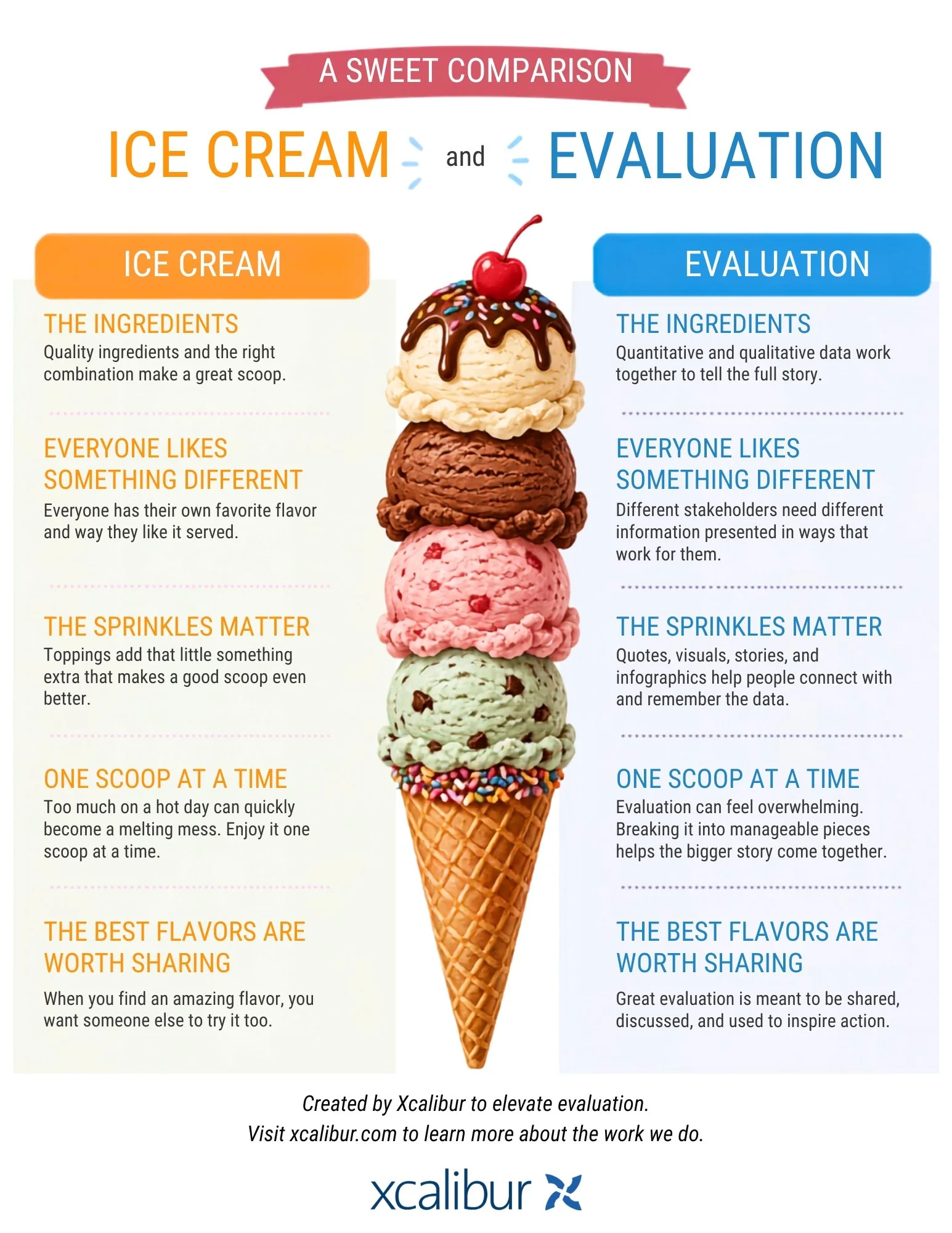
A Sweet Comparison : Ice Cream & Evaluation
There is just something about ice cream on a hot summer day. Maybe it’s the fact that it cools you down, maybe it’s the excuse to slow down for a few minutes, or maybe ice cream just makes everything a little better. Everyone has a favorite flavor, everyone has an opinion about the best toppings, and somehow, it’s always better when you’re enjoying it with someone else.
Believe it or not, I think evaluation has a lot in common with ice cream. When people hear “evaluation,” they might immediately think of spreadsheets, reports, surveys, and a whole lot of data. And yes, those things are part of it (and personally, I happen to love a good spreadsheet). But evaluation is so much more than numbers on a page. Good evaluation helps us understand what’s working, figure out what might need to change, tell the story behind the numbers, and ultimately make better decisions about what comes next.
So, what does all of that have to do with ice cream? More than you might think.
The Ingredients
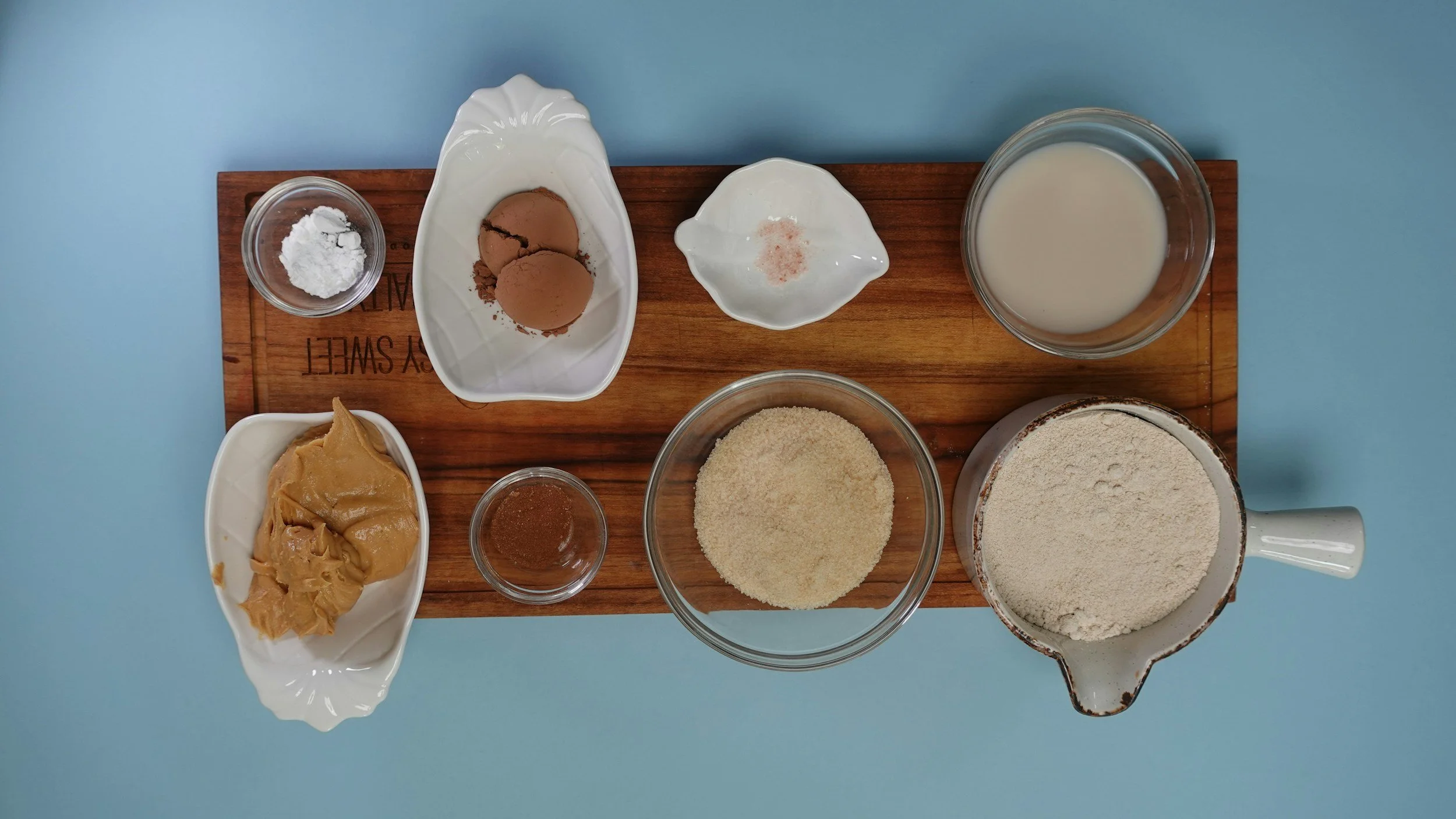
Great ice cream doesn't happen by accident. It takes quality ingredients mixed together in just the right way. The right balance of creaminess, sweetness, and flavor is what turns a simple scoop into something you really want to enjoy.
Evaluation works the same way. Quantitative data gives us a strong base, but the numbers rarely tell the whole story. That’s where qualitative data comes in. Student voices, family experiences, educator perspectives, program participation, outcomes, observations—they all add something different. A percentage can tell me what happened. A conversation with a student might help me understand why. Put those pieces together, and suddenly we have a much richer picture of what’s actually happening in a program. Leave one of those ingredients out, and something just feels…missing.
Everyone Likes Something Different
Anyone who has ever stopped at an ice cream stand knows that no two orders are quite the same. Some people stick with classic vanilla every single time, while others look for the most adventurous flavor on the menu.
Stakeholders aren’t all that different. A project director might want a dashboard full of outcomes. A school counselor might just want to know, “Okay, what does this mean for my students?” A funder wants evidence of impact. Families want to understand how the program is helping their kids. Same evaluation. Same data. Very different needs. Part of good evaluation is figuring out how to serve the information in a way that actually works for the person receiving it. Because it doesn’t matter how great your findings are if no one understands them—or knows what to do with them.

The Sprinkles Matter
Let's be honest, ice cream without toppings is still good. But sprinkles? Hot fudge? Fresh fruit? Whipped cream? Those are the things that make it a little more fun. And according to my 3-year-old, ice cream without rainbow sprinkles is barely ice cream at all.
Evaluation has its own version of sprinkles:
A student quote that perfectly captures an experience
An infographic that makes a complicated finding easy to understand
A one-page brief someone can actually read in five minutes
A story that helps explain the individuals behind the numbers
Those things don’t replace good data; they help people connect with it. I can hand someone a 50-page evaluation report (which, for the record…I’ll never do!) packed with charts, tables, and statistics. But sometimes it’s one student quote, one visual, or one simple finding that sticks with stakeholders way longer than a door-stopping report that no one will read. Those are the sprinkles!
One Scoop at a Time
We’ve all been there—you get a little too ambitious at the ice cream stand on a hot summer day, and suddenly it’s melting faster than you can eat it. You’re trying to keep up, it’s dripping down the cone, and what was supposed to be enjoyable starts to feel like a sticky mess.
Evaluation can feel the same way. There are surveys to administer, data to collect, outcomes to measure, reports to write, and plenty of numbers to sort through. When we try to tackle it all at once, it can quickly feel like more than we can keep up with. But we don’t have to do everything at once. Every survey response, focus group conversation, and data point tells us something and gives us another piece of the story. Every success—or challenge—gives us something we can learn from. Sometimes, the best way to approach evaluation is the same way we approach that ice cream cone: one scoop at a time. And when we do, all those individual pieces eventually come together to tell a much bigger story.
The Best Flavors Are Worth Sharing
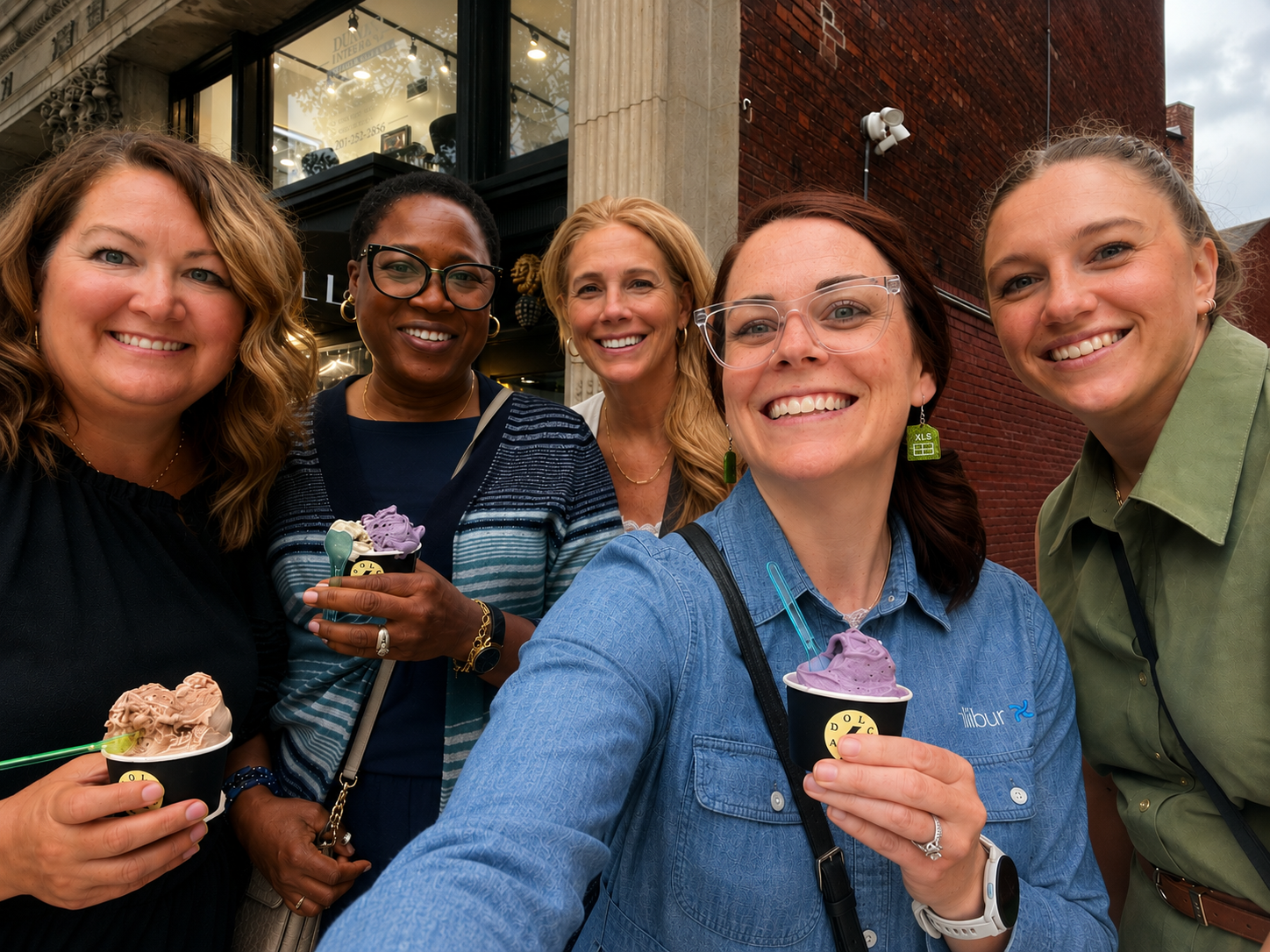
You know when you try an amazing ice cream flavor and immediately tell the person you’re with, “You have to try this!”? When something is that good, you want to share it. I think great evaluation should be the same way.
The goal of evaluation isn't to produce the longest report possible; it's to create something people actually use and share. That’s the part of evaluation I find most exciting. When evaluation is approachable, people start asking questions, they get curious, they want to dig a little deeper, they start using the findings to improve programs, celebrate what’s working, rethink what isn’t, and make decisions about where to go next. That’s when evaluation stops being something we have to do and starts becoming something genuinely useful. The most impactful evaluation doesn’t sit on a shelf—it starts conversations, brings people together, and helps a team look back at what they’ve accomplished while also asking, “Okay, so what do we do next?” And to me, that’s really what evaluation should do.
So, the next time you’re standing at an ice cream stand on a hot summer day trying to decide between your usual favorite and that new flavor you’ve never tried, maybe evaluation will cross your mind! Okay…probably not. But if it does, remember, great evaluation is a lot like a really good ice cream cone: it starts with quality ingredients, gets a few added sprinkles, and is served in a way people will enjoy. And most importantly, it’s good enough that people want to share it– and come back for another scoop.